Some years ago I started to graduate from board games into both role playing games and war gaming. My first real WWII wargaming experience started with the venerable Avalon Hill game called Squad Leader. I didn’t play with miniatures it was of course all cardboard stock chits.
Squad Leader, like Flames of War is a company level based game. Squads (and later half squads) and their equipment represented by counters on a hex map yielded a game with lots of flavor and some really fun scenarios. It included a point system for putting together games. It also included a system were you could have your own “command” counter that you could track experience points and make your way up from Corpl through the ranks, gaining better morale and leadership abilities as you go as long as you were able to survive.
So this article is all about adapting a bit of that old Squad Leader charm into playable Flames of War scenarios.

The first scenario in Squad Leader was called the Guards Counterattack, part of the battle of Stalingrad and this captures the action on Oct 6th 1942 when the 37th Guards threw themselves at the German lines. So in the above, you’ve got the order of battle. In Squad Leader terms these are squads which in Flames of War parlance generally equals 2 stands of infantry. Now equipment in Squad Leader is just a piece of equipment, assign it to stands as you may. But not quite the case in Flames of War as gun teams effectively crew and “own” a weapon, thus you have to have that kind of gun time. Still, that’s perfectly ok.
Also note that the Leaders in Squad Leader have more of an effect as compared to what they do in Flames of War. That 10-2 on Col Berki means his moral is a 10 and he gives a 2 leadership modifier for his men presuming he passes his morale check.
Like Flames of War, Squad Leader has a points system, based on the thing you’re buying as compared to by the unit formation in Flames of War. So a German 4-6-7 stand (4 firepower, 6 range, 7 morale) is 25 points. A Russian 4-4-7 is 20 points and those 6-2-8s are 60 a piece. So we start to have some direct things to compare in order to make it a Flames of War game.
Terrain is another important aspect and this is where things can get into a bit of a challenge. I say this because Flames of War games tend to be a smaller table. Granted in my gaming groups we tend to treasure the sprawling tables that enable out of control massive actions.
Squad leader is hex based on a set of game boards. the first scenario actually is limited to just a part of a single board, which translates well. The area of the board for this particular scenario looks like this.
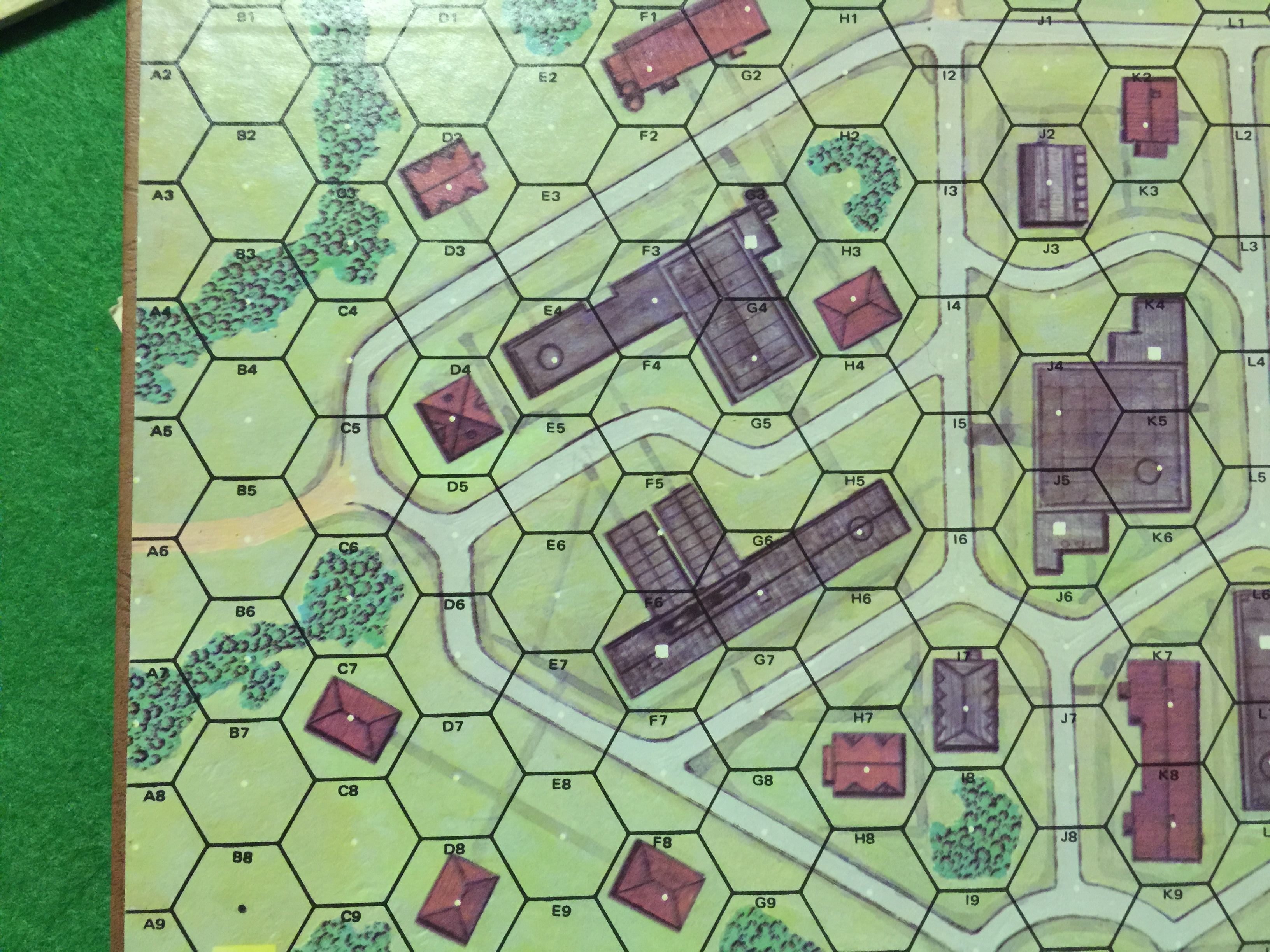
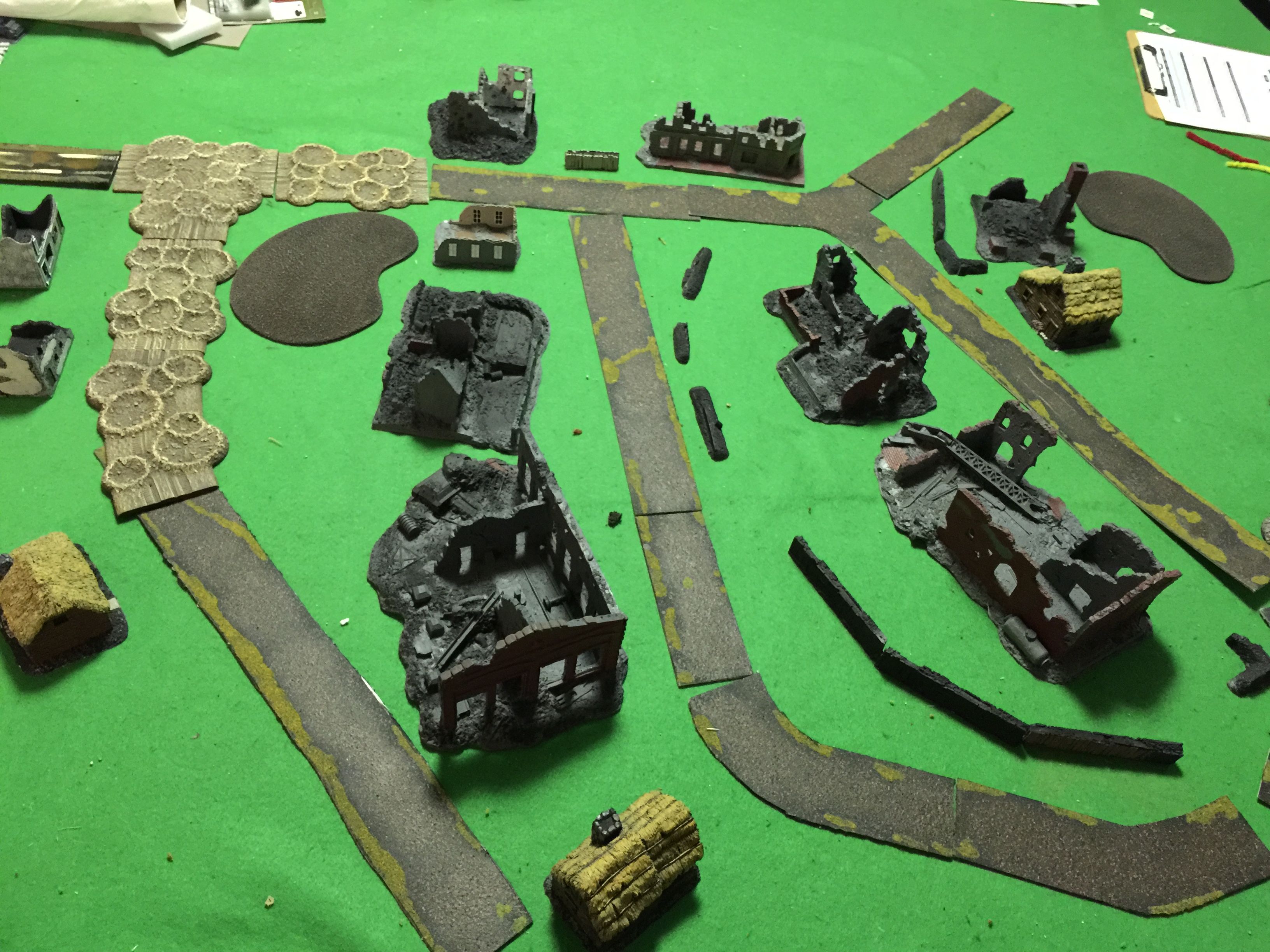
So translated into a game table. I’d interpret it to be approximately something like this. Note the table pictured here is basically the map rotated 90 degrees. Hex H7 / I7 is in the upper right. Hex I2 in the upper left.
Let’s talk about forces. If we let each squad chit in Squad Leader be equal to two FoW teams, as a rough guide and if we let the existence of an LMG equal to say a Rifle / MG team and MMG or HMG chits equal to elements of a machine gun platoon I think we start to have a reasonable mapping.
So in the the case of the Squad Leader specified German resources it equals in FoW roughly:
- Company HQ with CinC and 2iC.
- 3 section Rifle / MG platoon – confident vet
- 3 section Rifle / MG platoon – confident vet
- 3 section Rifle / MG platoon – confident vet
- 3 section Rifle / MG platoon – confident vet
- 2 MG section – confident vet
Russians approximately would be:
- Company HQ CinC, 2iC, Kommisar team
- 3 SMG Guard Platoons – fearless trained
- HMG Platoon, 2 sections – fearless conscript
- 1 Rifle Platoon – fearless conscript
It roughly equals to about 800 pts a side but the Russians are a bit short and thus I would add say 4 76mm/obr 1927 guns to even out the points.
Will play it out and let you know how it goes!