
We gathered last night to play test Across A Deadly Field. This is the recent ruleset that was the work of John Hill the author of Johnny Reb as well as a number of other sets of rules including Squad Leader. Sadly John just passed away a few months ago. The second expansion book, will be out any day now which I believe Dean West helped out to finish.
As there were four of us, and we’re all long time fans of Johnny Reb, we were eager to see how this one would play. We decided to play the “Tain’t no militia” intro scenario from the rulebook.
We pulled down these handy quick reference charts as the Osprey guys, while printing nice pretty books, they really don’t provide essential charts to give a player what they need for on the table top. Without these charts you’re doomed to having to flip through the book as there isn’t even a index. Charts

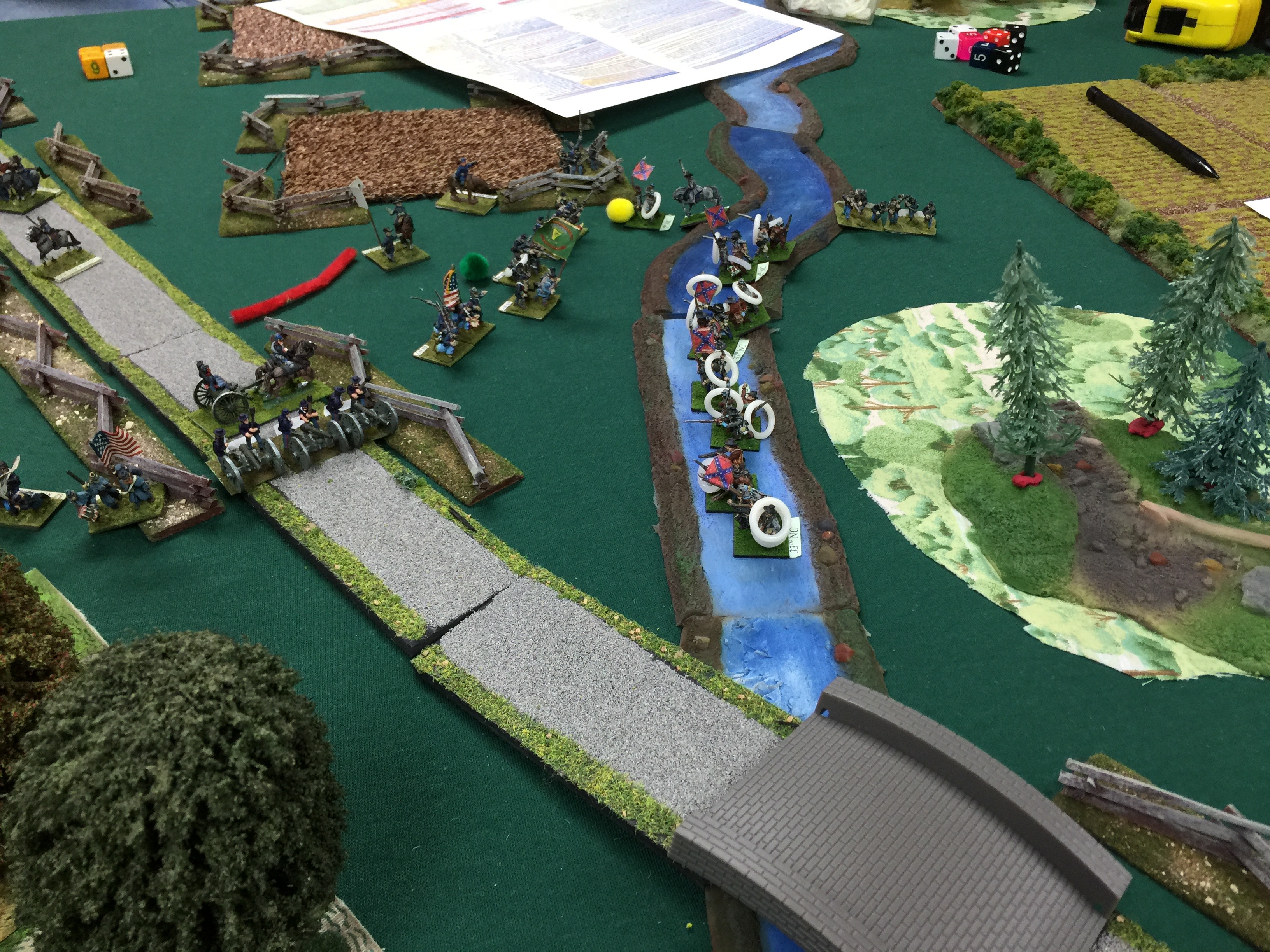
In this game, it was one of the initial actions at Gettysburg where two brigades from the 1st Corps, 1st Division were tasked with holding off some of the initial Confederate attacks. Here you can see the Reb artillery on Herr Ridge.
First problem, with the table set it as it was, it was much larger than the scenario setup called for. Unknown to the Union players the Reb artillery couldn’t advance off the ridge and thus we had to double basically everything in order to make the scenario work.
The first thing you’ll notice if coming from Johnny Reb is that the Across A Deadly Field regiments are pretty small. 4, 6, 8 figure regiments are pretty common. In the game you can either have 2 or 3 stand regiments. In Johnny Reb usually you have 4 stand regiments with 12,16, or maybe 20 figures.
In Across a Deadly Field, there is a large collection of artillery and muskets modeled in the rules. These are well explained and by the looks of it add a lot of flavor. Except, the firing table then sort of loses it. To fire it’s roughly 1 figure equal to a fire power factor. You add or lose 6 sided dice based on range, point blank, short, normal and long and then have pluses or minus to the roll based on cover, infantry formation and so on. So a 4 figure elite unit firing for the first time with enfields at normal range might be something like 2D6 (normal range) + 1 (elite) + 2 (first fire). The outcome of the fire might be a moral check, moral check with minuses, to loss of some number of figures.
If as a 4 figure unit, you’d basically have 2 stands of 2 figures. Lose two figures and you’re base moral goes up. A lot. You’re also down 50% and called a depleted unit which then you get a bunch of limitations.
So back to the game. I took a brigade of Rebs and Chuck took a brigade, and we squared off against Eric and Aaron who each had a brigade of Union boys.

As we were using Johnny Reb III based lead, we had to made due best we could to fit figures into the system as the scenario called for. My 3 regiments were 10, 10 and 8 figure with the two 10 figure units being rated trained and the 8 vet. Chuck had 5 regiments, 4 with 4 figures and 1 with 6. Most of his stuff was rated elite.
Our job was to push the Union back so I came at it from the left flank and Chuck from the right with our artillery on the hill, plinking away from long range.

In this game, it’s a you go, I go setup. The side going is the active player and the other side is the reactive. This means that when a unit uses an action and you get 2 actions when you are the active player for each regiment, the reactive player has the opportunity to use an action to “react” to the unit that is active. So if they fire at you, you could return fire. If they move, you could fire at them. They move, you could turn to face or rally, but you can’t move. There are limitations, you have to be able to “see” the unit you are reacting to, or at least have a commander that can see then yell at the regiment to do something.
In theory this seems like a good system. You must choose wisely or burn your action to early and get stuck by a later unit that might come up on your flank or change and be unable to do much in response.
The down side is the reactions. We had one situation where Aaron had a union infantry regiment on Chuck’s flank. Chuck’s action was to move forward, all Aaron could do was fire, he couldn’t opportunity charge. Maybe we read the rules wrong but that just seemed odd.
Add command figures, regiments in command gain benefits. Out of command, moving costs 2 actions, in command moving costs 1 action. That worked and made sense. What didn’t make sense to us was there didn’t seem to be a commander casualty rule when a commander gives benefits as part of a charge. Consider a commander on the side receiving a charge, he can be unattached and give morale benefits.

This is our Confederate line across from the Union. With the center Union regiment disordered should be a great opportunity to charge their lines, right?
Well.
So Chuck at this point charged with his whole brigade as a “group”. The rules allow you to basically group regiments together for fire and charges.
Aaron at this point was faced with a choice, fire now, or hold, chance passing a morale check and if he passes get a 4D6 point blank shot. He decided to go for it.
So Chuck came forward, he get’s to the 1 inch point, Aaron then starts to make his morale rolls for each unit. Given Elite status with a base morale of 3, and just enemy infantry close by for a +1, 2 of the 3 regiments just need to roll a 4 or above and they get their point blank shot. Pretty easy really.
The 3rd disordered unit has an additional +2 for being in disorder so 6 or above and it gets to fire point blank too.
All 3 pass. Aaron tallies up the fire power factors and it’s like 15 all total. (2 6 figure units and then the 6 figure unit in disorder gets 1/2 fire power factors for being in disorder) So 15, +1 for Elite and -1 for firing at Elite + 4D6. The result is a 3 figure loss. So at this point with some going back and forth in the rule book it wasn’t clear what to do. We we apply the hits across the line? Do we apply the hits all on one unit? We couldn’t find guidance on that one. We ended up applying 3 hits across the line which for all of Chuck’s 4 figure units gets them dangerously close to being down a stand.
Then comes the impact of the charge. This is a tally of base morale with then good and negative modifiers figured up and added to the respective side’s 2D6 die roll with the higher side being the victor or in the case of a tie a melee. So for Aaron, we figured it was base morale of 3 (elite), -2 for leader nearby and then we again hit a what do we do sort of moment. Of Aaron’s 3 units, 1 is in disorder. Do we impact everyone across the line with a +3 modifier for that? Do we add everything then up per stand for the charge and divide by 3? Again we didn’t see what we should do. We just added a +1 by the following logic with +3 / 3 units, it’s 1, so add one. For Chuck, no leadership but units in support so 3 base morale with -3 for the units in support for a base zero. Chuck and Aaron roll and Aaron ends up winning by 4. Chuck gets pushed back and suffers a further 1 figure per unit loss and now it’s down to depleted stands across the line of his brigade.
It’s game over at that point.
So on the charge, it wasn’t clear how to execute it for a group. The one example in the that talks about a group charge doesn’t actually talk about the impact and how that’s resolved. Another head scratcher I’m afraid.
With the table talk after the loss of hold fire and opportunity charges seems significant. The small units while great at the possibility to do large actions, are extremely brittle. They’ll last maybe a turn or two engaged but otherwise effectiveness is gone. For small units, just getting a hit is hard unless you combine fire. Even then with combined fire, it’s kind of unclear how to apply hits.
With brittle units might be result in faster play but I’m not sure that was needed.
All in all, I personally like how the rules read and I think I can see the mechanics trying to be modeled and how it was trying to address some of the short falls of Johnny Reb. The rulebook seems less than clear in spots or we mis-read or mis-interpreted what could be pretty fundamental things
I think we’ll give Across A Deadly Field another try yet before a final decision. Need to get out on some fora and ask questions.
Nice battle report. While not an expert by any means, I have played five games of ADF and eventually it will be my go to game for big games (above a division on a side) and will seek it out at conventions. Those five games were moderated by Dean West and Patrick LeBeau so the rule book was not really looked at. It was more like “OK what next”. Have all three of the books and reading them again with more understanding. As with most of John Hill’s games, play them five times before you rule them out. The subtleties will eventually become evident. Thanks again for the report.
Disordered figures count all figures towards the max of 16 figures firing, so 2 disordered 8 figure units would fire as 8 figures and that would be the max fire that would be done in that fire.
Hi Tom,
Very good report on playing your first ADF game. I regret the problems you experienced, but congratulate you on doing as well as you did considering you did not have access to the reference chart, which does a great job of bringing everything together into a coherent whole. John’s initial camera ready draft of the rules (45 pages) included the best reference chart I have ever seen. Unfortunately, one criteria of any Osprey rules set is that allinformation must be included between the covers of the book, so they excluded the free standing reference chart, and instead disassembled it and spread the information across many pages of tables and charts in the back of the book. This makes it very difficult to learn the game.
The lack of a reference chart issue emerged immediately when several war game magazines play tested the rules and experienced many of the problems you guys experienced. It became apparent to everyone that, indeed, the reference chart is an essential tool essential to tying the game together. To their credit, once Osprey understood its importance, they authorized the Cigar Box Battle blog site to provide John’s chart as a free download. So you can go to that website and obtain the chart. Unfortunately, it is taking time for the word to get around that the reference chart is, in fact, available at Cigar Box Battle. I’m going to end this post now in order to determine if I input enough “details below” to publish. If it does publish, I will continue explaining. If it does not, I will go to the face book page to communicate.
Dean
Much appreciated Dean! I did link to the reference charts I found on cigar box and boy are you right they are essential. While it’s too bad they aren’t in the book, the great thing is with a little searching on the internet Google will happily point the average person in the right place.
Hi Tom,
Glad I could help. Thanks. Unfortunately, the problem IS getting the word out that there are reference charts available. I doubt many gamers who buy the ADF rulebook think, ” Hmm, I wonder if I should check Google to see if there might be reference charts out there.” CBB has tried to spread the word as best it can, but it is not yet that all gamers go to CBB, though they would be well-advised to do so:)
Dean
Disordered units count all figs towards the max of 16 figs per fire, so 2 disordered 8 fig units would fire with 8 FP factors and that would be the max for that fire.
Okay, so that worked and now I’ll continue answering specific questions. I cannot cover everything, but the following is meant to point players in the right direction, and the reference chart accomplishes this much better than I can do it here.
First problem. Small units.
Unlike most games, combined units formed in “contiguous lines” can fire in multiple regiment volleys of up to sixteen figures each (“Contiguous lines” are essentially brigades formed in one line – or in two lines with the second line close behind the first – both standard Civil War Brigade formations.
For example, a brigade line consisting of, say, five six-figure regiments formed in a single line would total 30 figs. Since the regts are in a single line, The rules allow the player to fire one 18 figure volley from three regiments and one 12 figure volley from two regiments. Two figures of the 18 volley would not count, but still, a 16 figure volley can be very effective indeed, certainly more chance to be effective than firing three 6 fig regts. independently (although you COULD still do that). A 12-figure volley can be pretty effective too. When you guys did that in your game, you correctly divided the casualties as equally as possible among the target units in the Primary Zone of of the contiguous line. This manner of delivering volleys is way more effective than five six figure volleys. We want to compel players to fight their troops in brigade formations and the ability to fire multiple regiments in one volley does the trick.
Even so, I am not a fan of two-stand units and prefer three stand units. Three stand units are more impressive on the table and also more effective in combat. Trying to fight many tiny units drives me crazy. Three stand units can contain up to 12 figures. I use the following unit organization.
Six fig unit – three 2-fig stands (unit frontage of 360 actual soldiers formed in two-rank line mounted on three 5/8″ stands which gives a scale unit frontage of one inch & 7/8″. This si the smallest unit I suffer in ADF, and I go to great lengths to consolidate them into multiple regiment units, since ADF focus is on fighting LARGE battles, although small battles are fun too. My two scenarios in .
Eight fig unit – one 5/8″ command stand mounting 2 figs, and two 3/4″ stands mounting 3-fig (frontage of 480 actual soldiers, which gives a scale unit frontage of 2 & 1/8″ )
Nine fig unit – three 3/4″ stands mounting three figs (frontage of 540 actual soldiers, 2 & 1/4″ unit frontage
Ten fig unit – one 1″ command stand mounting four figs, and two 3/4″ stands mounting three figs (frontage of 600 actual soldiers, with a regimental frontage of 2 1/2″.
The larger regiments can fire effective volleys all by themselves, and there will inevitably be situations in games where a player wishes to Active Phase (two actions) individual units
I even allow twelve fig units. Three 1″ stands mounting four figs. 3′ regimental frontage.
Sometimes, I combine historical regts to form larger units, actually wings, or small brigades, containing up to 12 figs. For example, say an historical brigade you are modeling for a specific battle contains four 240 man regiments, or 960 total strength. Instead of modelling four 4-fig tiny PIA units, I would model the brigade as two wings, each of 480 men, or two 8-fig maneuver elements, one labelled, for example, 2nd & 40th IN, and the other 16th WI & 33 IL.
Some brigades had even less men, say 600 men, and one might model them as just one maneuver element of ten figs, labeled, for example, Hazen’s Brigade.
For some good examples of this system, please review the OBs in my Champion Hill scenario in “The War in the West” scenario book. One reason I chose this battle (other than the main reason, which that it is a balanced historical fight) is that many of the Confederate regiments are large, ten fig units. To compensate the Union, in that scenario you’ll find numerous combined regiments in the more worn down Union army of Grant as a matter of play balance.
NOTE: In charges by contiguous lines, the dice down outcome is determined by mandating that the two largest opposing units become the “impacting units” and the outcome of the impact is based on total figures + 2D6 roll plus SUBTRACTING net negative DRMs from the total fig/2d6 roll. EXAMPLE: 9 figs in impacting or “controlling” unit added to 2D6 roll of 7 for a gross roll of 16. This unit has a BMP of 4, is charging, and has 2 supporting units, for a net MMP of 1. The one is subtracted from the 16, for a net impact number of 15. Obviously, if the largest unit in a contiguous charging line is a 6-fig unit, it will start off the dice down calculation THREE figs (or pips) weaker than the nine fig unit.
Will end for now and pick-up later. However, I need to say that though I was part of the ADF design team, I was NOT an early adopter of the ADF system. After all, I might be the most die-hard of all JR players, since I was involved in the design of all the variations of that simo-movement game. I love simo-movement. However, the more I play ADF, the more I comprehend that the Active-Reactive phase system, where any unit or group of units MUST COMPLETE BOTH Active actions before the Active player moves any of his other troops, creates a tactical environment more subtle and realistic even than simo-movement. The ADF system is way more subtle and interesting than the mundane I Go-You Go system. It actually recreates the feel of simo-movement without the order counters. The more I play it, the more I agree with Patrick Lebeau that ADF is John’s ACW masterpiece. The problem is that John, a true war game design genius, is gone forever. But he has left us these three books, sort of sacred war game texts. They are somewhat flawed because he only had six-months to write them from scratch, but a few of us must carry on to further interpret them in order to assure the place of ADF amongst the other great games constituting the suite of Johnny Reb game designs.
Thanks much for the charge explanation as well as the fire explanation. I presuming with a 3H result, and the upcoming -3 MC, if you distribute the hits across 3 units, that would mean they would also take a -1 MC for each unit receiving a hit as compared to a -3MC across the line?
On the charge as a line, again thanks for the clarification! I gather that leadership modifiers don’t apply? IE if a -1 or a -2 leader joined the brigade to lead them forward that positive modifier isn’t used, it’s just negatives?
All in all, I really like how the rules read and the act/react aspect appeals to me as it fits the flow of having drilled to Casey’s over the years as a reenactor.
Thanks again!
Hits would be distributed differently on defensive fire on a charge vs normal fire. On normal fire- a 3H result would be distributed among the 3 targets as 1 hit and -1 moral mod each. Defensive fire against a 3 unit charge would be 3hits and -3MC on the lead unit and 1Hit (and a Hi/Lo) roll for a 2nd kill and -1 or 2 MC on each unit. A Leader could use his leader benefit in a charge if he was attached during the C&C phase. With 3 hits, the leader would roll 3D6 and any 6 would kill him.
Hi Tom,
Well, as long as we’re going to get into the details of firing at a charge, the ability of units in a defending contiguous line to ALL fire at the largest charging unit is based on how much of that unit comes into the defending units’ Primary/Secondary fire zones. (I call the largest unit the “Guide Unit” because the rest of the charging units in the contiguous line are guiding on it during the attack. There is a diagram of all this target stuff in The War in the West scenario book, in the chapter entitled Rules Clarifications and Additions, on Pages 15 and 16.
Dean
In paragraph five above I failed to complete a thought, which I will now do. My two scenarios in “In the War in the East” scenario book focused on two small but complete battles, New Market and Piedmont. I wanted to show that small battles can be fun using ADF. I hosted Piedmont at numerous gaming cons in 2014, and the players were engaged and had a great time, especially the victors. In “The War in the West”, I designed Champion Hill, a fairly large battle. I wanted to design a large battle in order to illustrate how ADF works to fight a big one in its entirety (not a segment of one). At NASHCON we fought the battle with players who were largely unfamiliar with the system, and that game was a success, the guys seemed to have fun, and we had a result in about six hours. We intend to host another Champion Hill game at Historicon in July, as a second Memorial Game dedicated to the memory of John Hill.
Chuck, the other Reb commander in the game here. I would like to weigh. The charts were absolutely essential. We would not have been able to complete the game if we hadn’t had the charts.
I wouldn’t recommend this scenario for new players. If so, at least allow the rebs to be able to move the guns. We figured out that the Union players had the advantage in manpower (numbers and quality) and had the benefit of defending.
As Tom said, for the table, the player who set up the table set it up on his 6’x6’ table in his game room. When we went to play, we realized that the game was supposes to be played on a 3’x3’. Given that the Rebs only had four turns to get to the other side to occupy our objective, it wouldn’t have been possible to accomplish our objective even with no Union troops on the board. And our guns couldn’t even fire a shot at the Union soldiers where they set up. The scenario says the guns can’t be moved. There wasn’t time to re-set everything so we just doubled the ranges and movements. For what it is worth, I don’t think it was a malevolent factor.
As the commander of the small Reb units, I realized that the best possible outcome I could have was to possibly get one casualty (4 man unit + 12 from 2d6 +1 for elite) on a 3% chance assuming the target unit wasn’t elite. Even with my opening volley I couldn’t get more than one figure. It just increased my odds from 3% to 16% for one action. So I knew I had to combine the regiments into groups. The trouble was my units were so spread out to start that I had to use the divisional commander and my brigade commander for three turns to get everyone in command. That meant the other brigade was not able to move as effectively which allow the larger Union forces to easily consolidate their forces.
At first I wasn’t really in favor of the “You go, I go” cycle. But as I played it, I realized that from an action-reaction cycle, it made a lot of sense and I like it now. I do think the available reactions need to be adjusted. As stated, the union was able to move up on my flank on their phase (I had already used my reaction for fire back on a unit that fired at me) and during my phase I was able to walk forward only getting flank fire. It seems like there should be an opportunity charge reaction when a flank it exposed. I was also trying to test the limits of the system. I was trying to take one of my battered, one-stand units in line with a commander attached and just walk past three Union units into his rear. I passed the flank fire but missed the next morale check by two. It would have been interesting to see what havoc I could have played with my second activity on the Union commander with no second line (he brought the reserve unit up to fill a hole in the line when one of the Union regiments advanced onto my flank).
I don’t like that units “out of command” cost double to move. This tells me that the regimental commanders had no initiative/battlefield sense. I would prefer if the commanders just added benefits to the units they are attached to. That way you attach them to the point of the attack/key defensive point.
I found it ironic that a commander had to be attached to regiment/group to move/give benefit in the attack but just had to be in command radius to give benefit in the defense? Perhaps we played this one wrong. Comments?
I do think that morale was way too easy to make if you hadn’t lost a stand. We didn’t have a unit route during the four turns we played and probably fifty morale rolls, although mine were in no shape to continue the fight after my “last turn let’s see what a group charge looks like” move.
As for the charge, I had four units going in. In my eyes the two units on the outside should have had -1 for units in support while the two in the center should have had a -2. If averaged six minus divided by four units equals 1.5 minus. With a -1 for charging, my net was either +1 or zero. This is averaged. But it doesn’t sound like that is how it is done.
We didn’t know that disordered figures count towards the total number firing (we knew that their FP’s were halved). It wouldn’t have mattered much as there were at least fourteen full strength figures in the other two units.
As I found out, while you can accomplish more fighting in brigade style in a continuous line, it really opens you up to getting flanked. That probably wouldn’t be an issue in a big game with support on either side. Even the six figure units have trouble scoring a hit on these tables.
My personal opinion, but I would prefer to do away with the -1 for firing at elite troops. A bullet to the head is bullet to the head. In a column, a charge or in a line, there is no ducking or making tactical use of dips in the ground. I can see it in skirmish mode.
I would prefer to see a standard figure per stand rule and a standard number of stands per unit. In our game, the Union had several two stand, four figure regiments. Even if I combined two of my four figure regiments into one eight figure group, I was not his equal when it came to taking hits. If we traded blows, at three hits one of my units would be at fifty percent with a stiff morale test while his unit would be safe and sound. The sole advantage I can see is that if I charge, I would get an enfilade benefit. I guess I would prefer to see stated standards of x figures based as x stands. For example, four to five figures, two stands, six to twelve figures three stands, thirteen to sixteen, four stands. Otherwise some gamers could manipulate the figures per stand to have uber tough units that are harder to kill.
When we read through the rules on group charges, we ran across the part about the two largest opposing units becoming the “impacting units” and the outcome based on their stats. This seems to ignore other units in bad morale, minimizes support modifiers, etc… In this example, even though I was hitting a line of three unsupported Union regiments (the middle unit was disordered) with a line four suppoerted Reb regiments, I was at a disadvantage because my units were all elite 4’s while the Union’s largest was an elite 8. Since both units were on the flank, I was only able to get one unit in support which seems crazy.
I want to play again but clarification would really help. Thank you.
Chuck, the other Reb commander in the game here. I would like to weigh. The charts were absolutely essential. We would not have been able to complete the game if we hadn’t had the charts.
I wouldn’t recommend this scenario for new players. If so, at least allow the rebs to be able to move the guns. We figured out that the Union players had the advantage in manpower (numbers and quality) and had the benefit of defending.
DEAN: Okay. There are plenty of good scenarios, especially in the scenario books, and we encourage the amateur or professional military historians among you to creat your own scenarios – “Slocum” not one of my favorites either.
As Tom said, for the table, the player who set up the table set it up on his 6’x6’ table in his game room. When we went to play, we realized that the game was supposes to be played on a 3’x3’. Given that the Rebs only had four turns to get to the other side to occupy our objective, it wouldn’t have been possible to accomplish our objective even with no Union troops on the board. And our guns couldn’t even fire a shot at the Union soldiers where they set up. The scenario says the guns can’t be moved. There wasn’t time to re-set everything so we just doubled the ranges and movements. For what it is worth, I don’t think it was a malevolent factor.
DEAN: Please review the explanation of the size of each hex. Note that in 15mm, the game can be played in ground scale the 18 inch hexes can represent 1” = 80, 90 or 100 yds. So, ground scale can be adjusted to represent one 18’ hex equaling a 1200 yds x 1200 yds square of ground, at 90 yds per inch, one 18” square equaling a 1350 yds x 1350 yds square of ground, and figuring one hex equals 100 yds, and 1800 yd x 1800 square of ground, or a couplehundred yards more than one square mile. I recommend using a standard 1 inch equals 80 yards standard, and then figure unit frontages at this scale for continuity. The Slocum scenario in the book is scaled at 1” equals 1800 yds. Hence, though the game surface is only 3’x3’, the game board represents a slightly more two mile square of ground.
As the commander of the small Reb units, I realized that the best possible outcome I could have was to possibly get one casualty (4 man unit + 12 from 2d6 +1 for elite) on a 3% chance assuming the target unit wasn’t elite. Even with my opening volley I couldn’t get more than one figure. It just increased my odds from 3% to 16% for one action. So I knew I had to combine the regiments into groups. The trouble was my units were so spread out to start that I had to use the divisional commander and my brigade commander for three turns to get everyone in command. That meant the other brigade was not able to move as effectively which allow the larger Union forces to easily consolidate their forces.
DEAN: See my earlier comments on using four fig units at all. Combine small units into multiple regt. Units, as was described.
At first I wasn’t really in favor of the “You go, I go” cycle. But as I played it, I realized that from an action-reaction cycle, it made a lot of sense and I like it now. I do think the available reactions need to be adjusted. As stated, the union was able to move up on my flank on their phase (I had already used my reaction for fire back on a unit that fired at me) and during my phase I was able to walk forward only getting flank fire. It seems like there should be an opportunity charge reaction when a flank it exposed. I was also trying to test the limits of the system. I was trying to take one of my battered, one-stand units in line with a commander attached and just walk past three Union units into his rear. I passed the flank fire but missed the next morale check by two. It would have been interesting to see what havoc I could have played with my second activity on the Union commander with no second line (he brought the reserve unit up to fill a hole in the line when one of the Union regiments advanced onto my flank).
DEAN:That is how it is supposed to be. This active phasing system mandates that the acting unit or contiguous groups completes both active moves before player goes to another unit or group of units. This creates a very rich tactical environment that requires even more thought than simo-movement.
DEAN:Regarding your regiment that was flanked at the end of your opponents active turn, note that you will get to “act” during your active phase before the enemy unit can fire into your flank because your active action precedes the reaction of the opposing unit. So you could have wheeled to face the flanking unit prior to receiving any flank fire (there is no FR in ADF). THEN you could have taken a non-flank fire from this formerly flanking unit as its reaction, and then you could have charged or fired back in your second action. These are the phase dynamics that Johnny Rebbers have to get used to when playing ADF. The action is different. Tactics are really more subtle due to the back and forth between being the active or the reacting player.
An editorial historical comment here — to be honest, though we gamers like the 90 degree charge to a flank in disorder, that is NOT a typical response in real combat situations. You’d be hard pressed to find a documented case. I’m sure it did happen, almost everything did, but was it a common tactical response? No, it wasn’t. Usually the flanked unit desperately tried to change frontage to face the flank (refuse flank), or it ran (disengaged). In other words, you could have bailed out of the bad situation your unit was in before the enemy was able to act from his flanking position (except you need not have feared the flanking unit because it was NOW your Active Phase). I know that at least in the Western theater, usual Confederate tactical doctrine was for a brigade to form in one single line of regiments in line. The longer the line, the easier it was to flank and enemy line, and it was well known by the Yankees that if one of these long rebel lines was in jeopardy of being flanked, it immediately fled (disengaged) before any flanking movement could have an effect, then reformed out of danger, and then came back to try again, usually.
I don’t like that units “out of command” cost double to move. This tells me that the regimental commanders had no initiative/battlefield sense. I would prefer if the commanders just added benefits to the units they are attached to. That way you attach them to the point of the attack/key defensive point.
DEAN: ADF can be played without using officer figures at all, but who among us wants that? The regimental commander certainly is using his own initiative, the unit can still move half (which is not nothing), and can fire, etc. But usually, coordination and tactical maneuver is enhanced by having a brigadier leading his men and we like to simulate that. Actually, brigade commanders in ADF only affect unit movement when they are attached to the unit, or to a contiguous sense. And if they are attached, they die on a 1D6 dice roll if the unit they are attached to takes a casualty, every time a casualty is suffered. Movement of the unit or contiguous group is improved by the leader figures Leadership Benefit, which is usually 1 (so 1” movement benefit per action). It seems to make sense to us to us that a brigadier who has his brigade well in hand can positively influence its movement. Officer figs can add a beneficial fire or morale benefit only to the unit he is attached. If not attached, but just near other units (see pages 55-58 in rules), he might be able to influence the morale of two units, but rarely more than that.
I found it ironic that a commander had to be attached to regiment/group to move/give benefit in the attack but just had to be in command radius to give benefit in the defense? Perhaps we played this one wrong. Comments?
DEAN: This is not a correct interpretation. A leader attached to a unit only influences the morale and fire of that one unit. Usually he’s with the Guide unit of a charging contiguous line, or an individual unit. If the leader is merely adjacent, he can affect the morale of maybe two units whether on offense or defense. See glossary.
I do think that morale was way too easy to make if you hadn’t lost a stand. We didn’t have a unit route during the four turns we played and probably fifty morale rolls, although mine were in no shape to continue the fight after my “last turn let’s see what a group charge looks like” move.
As for the charge, I had four units going in. In my eyes the two units on the outside should have had -1 for units in support while the two in the center should have had a -2. If averaged six minus divided by four units equals 1.5 minus. With a -1 for charging, my net was either +1 or zero. This is averaged. But it doesn’t sound like that is how it is done.
DEAN: Wow, either you guys are the luckiest dice rollers ever, or you are all deployed your troops in the best possible formation to maximize support and cover, or everyone is having a good night, or you’re doing it wrong.
DEAN: If you are properly deployed with the max number of supporting units to reduce BMP, then I think your units should stand up fairly well prior to losing a stand, and have a chance of standing even after losing a stand if properly deployed in an advantageous manner. We want to reward good use of supporting units and cover- in other words, good tactics. Units receive up to -2 beneficial DRM from supporting units within supporting unit on flank or rear, and up to +3 in charge situations. But your correct, units on each flank are usually supported only by one adjacent unit on one of their flanks.
DEAN: Also note othe fact that ONLY the two best and two worst morale modifier categories are used. For example, best a unit can do in a non-charge situation is probably -2 for the “supporting” category plus perhaps woods cover. Cannot not use any other modifiers. NOTE: One of the most helpful sections of the rule book is the glossary in the back.
DEAN: Also, certain morale checks and casualties add hurtful morale modifiers. Finally, in JR units rout on snake eyes morale rules, but in ADF a roll of natural 3 also causes bad things to happen to morale. Honestly, I have not noticed much difference in the incidence of bad morale roles in the games I have played in or hosted, except the natural 3 role seems come up fairly often.
We didn’t know that disordered figures count towards the total number firing (we knew that their FP’s were halved). It wouldn’t have mattered much as there were at least fourteen full strength figures in the other two units.
As I found out, while you can accomplish more fighting in brigade style in a continuous line, it really opens you up to getting flanked. That probably wouldn’t be an issue in a big game with support on either side. Even the six figure units have trouble scoring a hit on these tables.
I have talked about this. The flip side is the longer your line is, the more probable it is for you to outflank shorter enemy line, and there is no rule that you must always form in long lines.
DEAN: Technically, a contiguous grouping can be created by forming a brigade in two lines of adjacent units (in this case adjacent can mean within one inch “in rear.”
My personal opinion, but I would prefer to do away with the -1 for firing at elite troops. A bullet to the head is bullet to the head. In a column, a charge or in a line, there is no ducking or making tactical use of dips in the ground. I can see it in skirmish mode.
DEAN: The theory is that elite are more capable in using cover and so are worthy of an advantage. However, I actually agree with you because people forget this modifier more than they remember it, and with the two best modifier rule, it usually is not applicable anyway.
I would prefer to see a standard figure per stand rule and a standard number of stands per unit. In our game, the Union had several two stand, four figure regiments. Even if I combined two of my four figure regiments into one eight figure group, I was not his equal when it came to taking hits. If we traded blows, at three hits one of my units would be at fifty percent with a stiff morale test while his unit would be safe and sound. The sole advantage I can see is that if I charge, I would get an enfilade benefit. I guess I would prefer to see stated standards of x figures based as x stands. For example, four to five figures, two stands, six to twelve figures three stands, thirteen to sixteen, four stands. Otherwise some gamers could manipulate the figures per stand to have uber tough units that are harder to kill.
DEAN: I am the enemy both of two stand regiments or four figure units. I gave you my three stand regimental strength and stand size details in first post and that system works well. Let’s make it the standard! 🙂
When we read through the rules on group charges, we ran across the part about the two largest opposing units becoming the “impacting units” and the outcome based on their stats. This seems to ignore other units in bad morale, minimizes support modifiers, etc… In this example, even though I was hitting a line of three unsupported Union regiments (the middle unit was disordered) with a line four suppoerted Reb regiments, I was at a disadvantage because my units were all elite 4’s while the Union’s largest was an elite 8. Since both units were on the flank, I was only able to get one unit in support which seems crazy.
DEAN:The outcome of the dice down between the Guide or Impacting units affects EVERY UNIT in the charging group, and units in “bad morale” can’t charge, and neither can units that become disordered, and a disordered unit in line between other units severs the contiguous line.
I want to play again but clarification would really help. Thank you.
DEAN: I have done my best. I am actually the third most qualified living authority on ADF, so the superior ones, PJ a/o Patrick, may wish to weigh in too with additional info.
Best Regards, and thanks for your interest.
Dean
Dean, I think you answered most everything. Just a note on C&C. Officers attached to a unit during the leader movement phase help with 1+ FP factor and +1 movement. Officers adjacent (within 1″) can help with morale rolls and units within 4x LB (usually 4″) or a contiguous line allow a unit to be in C&C and move in each of the 2 actions. This is for both attack and defense.
P.J.
Well thank you PJ. Appreciate you overseeing my efforts. I think that’s pretty much what I did say about officers, though did mention the command control aspect- focused on morale benefits. but maybe not as clear as I would have liked, so referred them to the officer rules in the book.
I meant did not mention command control… Sorry.