
Having been one of the lucky ones to receive a copy of Runewars at AdeptiCon as part of my swag bag I’ve been super eager to play since this is a game I’ve long long looked forward too. My interest is fueled by it’s resemblance to AD&D’s miniature rules called Battlesystem which still to this day is played, at least locally from time to time.
Damien and I tried things out last night at Gamez and More and yes, using a 3×3 mat which normally would be for X-Wing…
For skirmish battles you generally play on a 3×3 surface, but for the ‘normal’ games they envision a 3×6. I’m guessing at some point we’ll see mats of that size released by FFG or others but nothing so far and besides it’s easy enough to throw out some felt or what have you to have a proper surface. I did spend about 10-15 minutes at AdeptiCon talking to the Cigar Box mats people about what Runewars needs for mats as I was looking to pick something up from them but alas not since they didn’t have anything.
So! To the game. Today with just the initial box there are just two factions to play, Daqan Lords or Waiqar the Undying. Basically noble knights or undead, with it would seem at least one if not two factions coming in the not too distant future.
I played Daqan and Damien took the Waiqar. We deployed everything in the box, in my case my spearmen to my left flank, one of my heros Keri next, then the cav, and last my golem on my fair right flank. O, the horrors of unpainted lead…. er plastic… nice plastic, and I mean really nice and well constructed plastic that’s easy to put together!
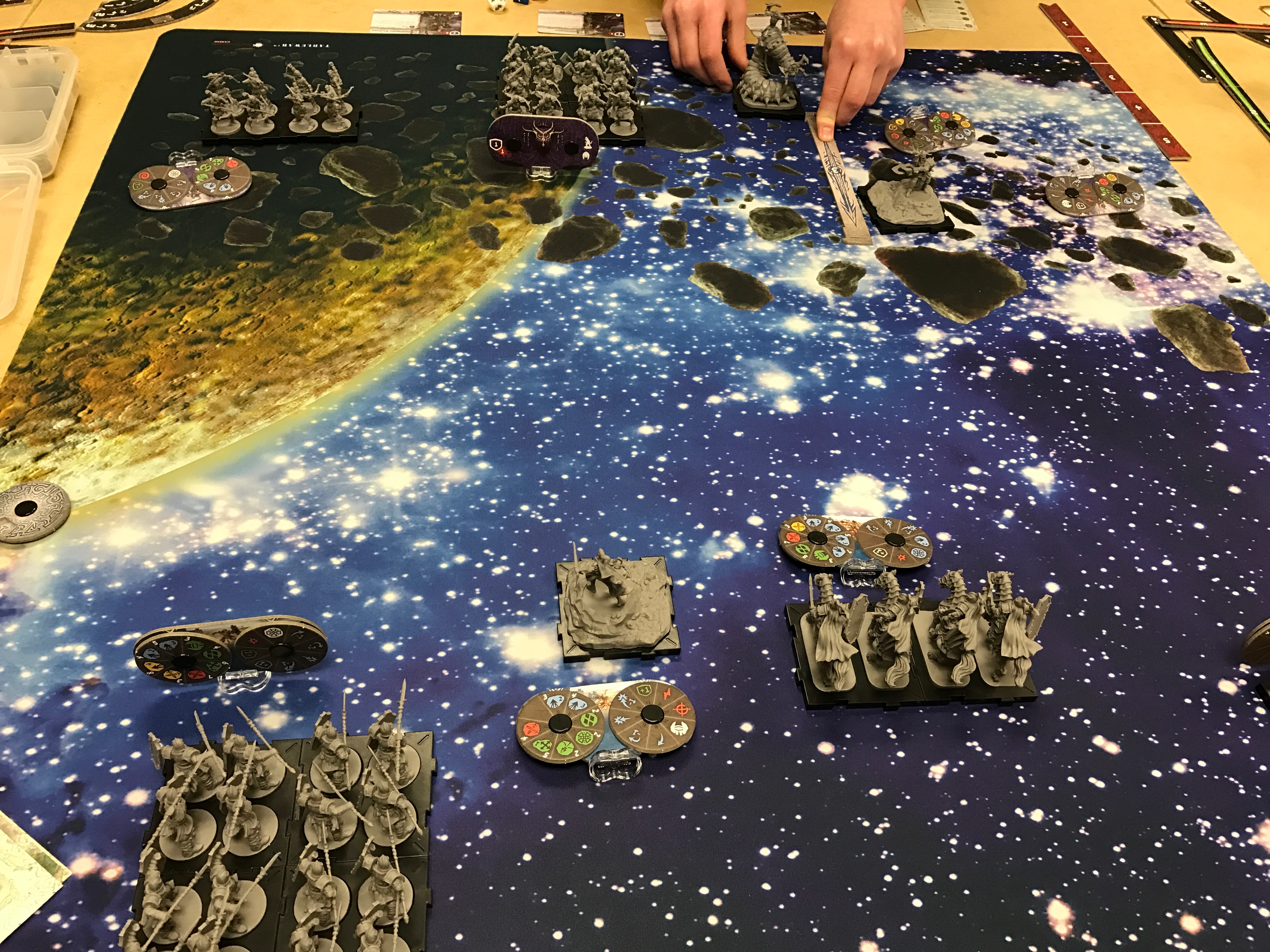
Playing the intro game, the first challenge we had to face was getting to know the command dials. On the left side of the dial is what command you’ll give your unit and on the right any modifier to that command. So as a for instance, you have a movement/march (or perhaps a couple of them, more in a moment as to why) command and to that command you can modify it with a charge, or banking turn or a hard turn. Not all units are the same. My golem for instance can’t exactly turn, so instead I have to give him orders to change facing instead of doing a bank or a hard turn. Makes sense, slow lumbering magic creature he is.
Next to the order is a number, that’s the order in which the unit will be activated. So one part of the game is keeping aware of what order of commands you have and what you’re facing. Do you want to attack quicker (and perhaps give up bonuses to the attack) or have a strong attack, going later in the round but having bonuses.
For activating a unit, you start rolling through the possible activate numbers. … 1 … 1 … Bueller, Bueller … 2 … 2… 3… o!
My lumbering golem as you’d expect tended to have high activation values. Charging cav, lower, etc etc. In the case of a tie or several ties, the person that is player 1 gets to activate 1 unit, then it goes over to player 2 to activate one unit, then back to player 1 if they still have another unit with that same activation number.
As a strategic element, this game mechanic worked really really well, downside if you want to do several players on a side in a super huge ultra mega battle, you’ll have people potentially sitting around watching while the one person activates that unit.
For the learning game, we just had the bare naked units. Normally in a game, you can add point costed upgrade cards to lend special abilities or armor or what have you to your gang.
Let’s get into combat….
Stat-wise, my spearmen have 1 shield, 1 health, which is to say, for every hit they take, they lose one guy. Where my Cav are 2 shield, 1 health, so it takes 2 hits to take out a figure from their tray.
The heros on the table tended to be 3-4 shield and 3-4 health.
For dice, there are 3 types, red, blue (both 8-sided) and white (12 sided). Most units seem to roll two dice when attacking. To enter into melee you have to be in base to base contact. How you do this is important, since if you just ‘walk’ into your enemy you gain a panic token (bad) but if you charge into them, you not only contact them but get to perform an initial attack.
Given the starter box, both sides only have 1 unit that can do a ranged attack. Ranged can go up to distance 5 on the ruler and there isn’t a penalty for distance. They are either in or out. You must have line of site when you do shoot and if you are targeting an enemy that is engaged with one of your own, well your guys get to suffer a morale test.
For longer term, I wonder about siege engines or giants throwing boulders, magic, where nuances on range while adding a little complication, also adds some strategic game play.
Anyway, a roll of the dice and then next challenge you’re presented with is calculating damage. It’s a function of first, how many hits you rolled on the die, how many trays wide you are that are engaged with the enemy (called threat) as well as any special abilities of your unit. It’s generally simple math but more than once Damian and I had to walk back what we had done and rethink if we had reached the right value.
In addition to hits, the die might also have a panic result, in which case you get to assign a panic token or two onto the enemy unit.

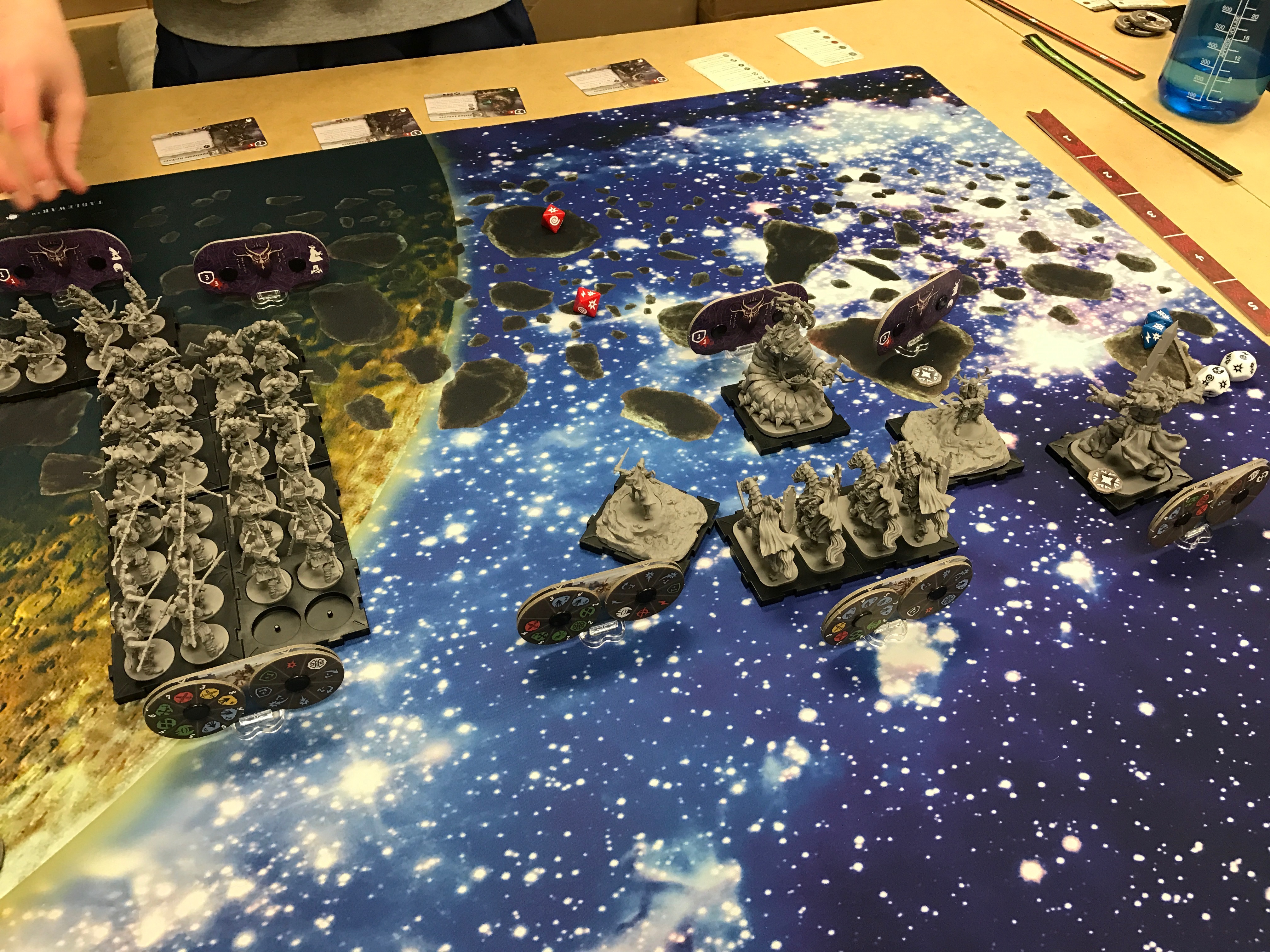
Towards the end of the game, my spearman where just about whipped out. You can see the panic token (the swirl) they currently have. At the end taking damage your opponent has the option of ‘spending’ the panic tokens as part of a morale test.
Say you have 2 panic tokens and your opponent decides to spend them both, you draw two morale cards. The morale cards each have a ‘cost’ in panic tokens at the top of the card. So in this case if they drew a 3 cost morale card, since they only had 2 panic tokens, they couldn’t choose that card to apply.
So given the cards drawn, your opponent gets to decide which one to apply to your unit. They might be effects like gain a blight or a stun, or cause you to march backwards, all sort of interesting negative effects.
If you look at the picture you’ll see my spearmen have a red token, that’s an immobilize that it received. If that unit tries to move, my opponent can spend that immobilize token and cancel that order.
There are other ‘bane’ types of tokens, like blight which causes you to roll one less attack die.
Opposite of bane tokens is a boon token called inspiration. You can can spend that to negate out a bane token.
Another result out of a die roll for combat are lightning bolt (called surges) and if you have enough surges, and a character that can make use of them, you can trigger special abilities, magic that kind of thing.
We managed to play 8 rounds (a normal length game) in under 2 hours, with the intro game, as you’d imagine we kept to just trying to learn mechanics and for the purposes of this post, that’s all I’m trying to give you a feel for.
As I start to dive into full rules reference, there are aspects to deployment, terrain, upgrade cards for units, and lots more to give full flavor to the game.
To me, this is a solid set of rules, and I’m holding it up in comparison to well loved, well worn rules that I’ve either played on my gaming table or on others. While it might not be set in the land of Greyhawk or Dragonlance, Tolkien or whatever, don’t let that steer you away.
Till next time…