Warlord games has come out with a new WWII flying game called Blood Red Skies. I happened to be able to get in a game of it last night up at Fantasy Flight Games as one of my friends has gotten into it.
I’ll state right off I’ve played a number of WWII air rulesets in hope of finding something that was kinda like a game of yore called Red Baron. Now with Red Baron you have to plot your moves, you have all sorts of stats and such to keep track of with aircraft mounted on sticks that go up and down for altitude. It’s great fun and well beloved.
For our group I’d say that Wings of Fire was probably the closes to that style of game. Check Your Six another that played ok but with it’s hex system was just a bit too simple so over time the replay-ability kinda suffered.
Blood Red Skies comes at the design of the game from a different and very refreshing direction that I’ll try to explain. I can’t cover it all, but here’s the highlights.
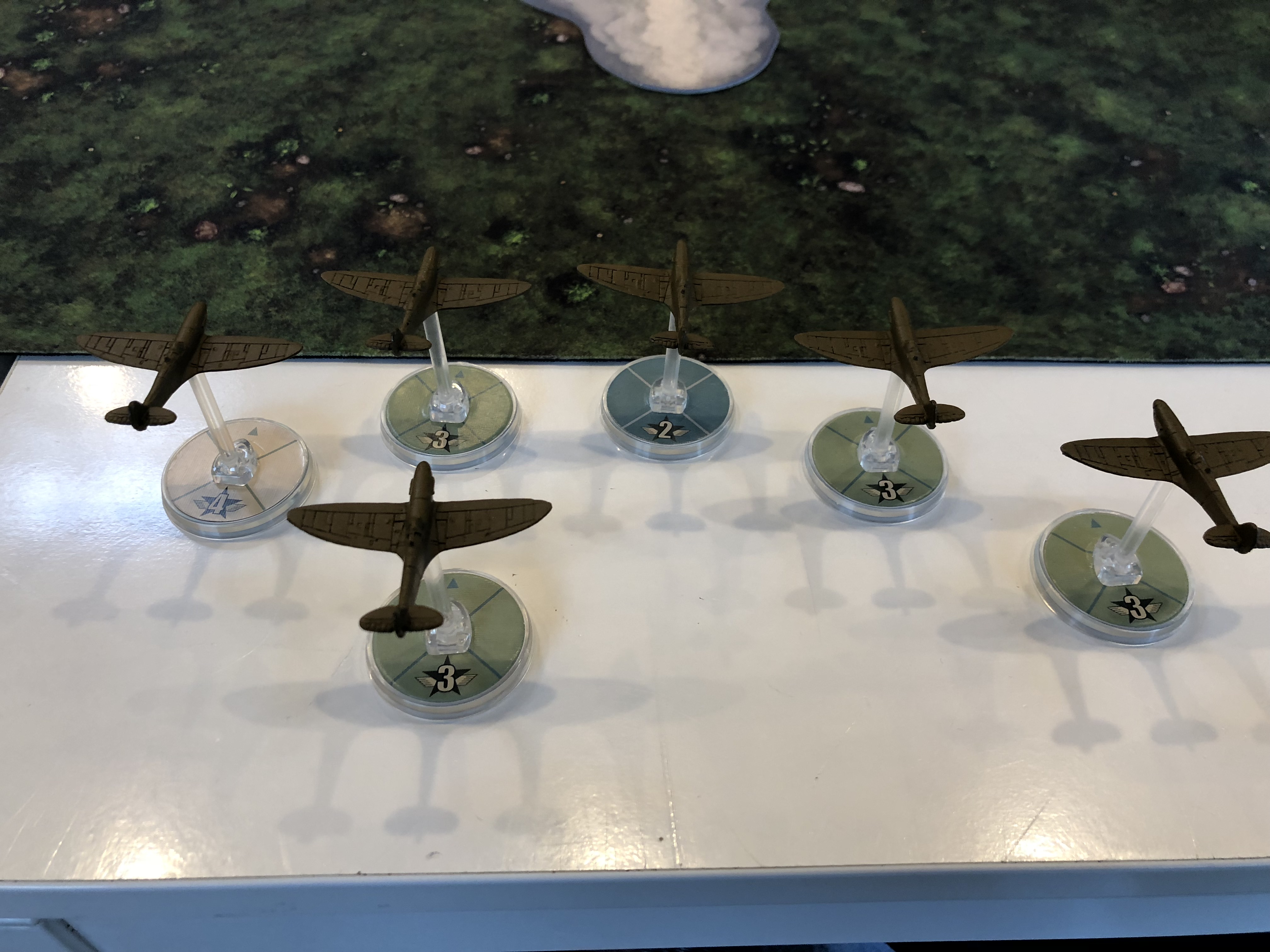
Firstly the models are 1/200. As the game is new the variety of aircraft is limited. Brooks and I had Spitfires and ME109s going at it in our game. Models are unpainted but otherwise numerous in the core box. (6 of each side depending on if you pick up a Battle of Britain, Pacific, or Russian themed box). The stands have the pilot skill 2 being a rookie, 4 being a skilled pilot. Lines clearly mark the firing arc. Tailing is actually being behind the plastic post, not the whole rear arc.
There is no altitude nor plotting in this game. For many a flying game how to design those iconic elements is very important. In Blood Red Skies, planes have 3 states, Advantaged, Neutral or Disadvantage. Gaining state takes an action and losing state can allow you to perform maneuvers or be forced on you by circumstances, like being tailed without a wingman.
A typical airplane activation is fire, move, then action.
This design element combined with a system of cards that are available to be used creates exactly the element of trying to jockey and outfly the other guy. Skilled pilots are still rewarded for being skilled pilots. Rookies likewise have to take care of themselves and also benefit strongly from friends to keep being shot down. Wingmen being important?! Who knew!
Shooting, pilot skill tests, avoiding damage, etc is all done through rolling a certain number of dice. Get a six on one of those dice and it’s success. Get multiple sixes and you might get rewarded depending.
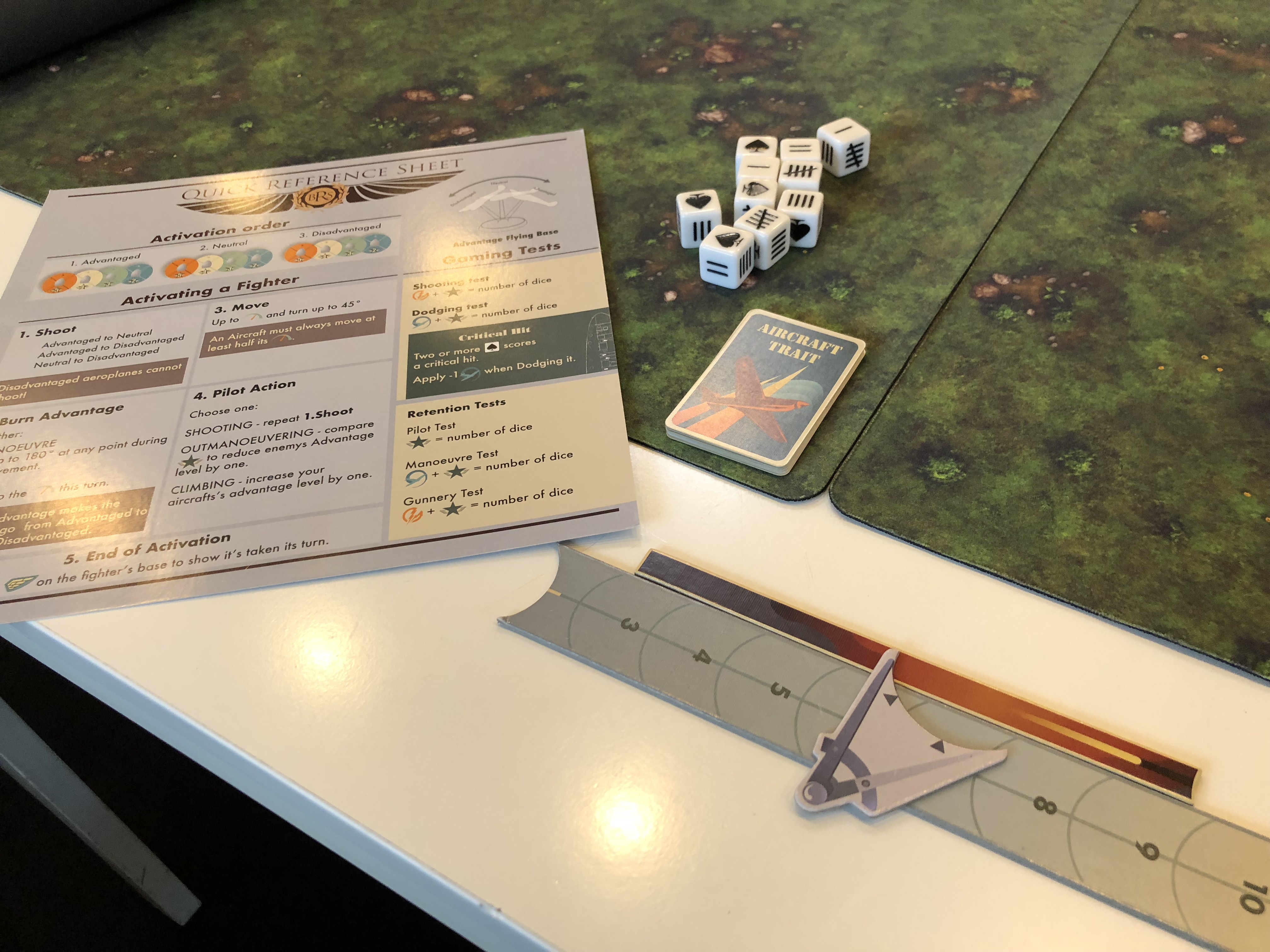
Shooting range thus far is just 6″. Deflection shots allow for more defense dice. Charts and support stuff is all pretty clear.
Activation is in the order of highest skill pilot that is advantages going first, then next skill level of advantaged pilot, then neutral planes started with highest skilled pilot on down and then disadvantaged planes.
Planes that are in the same or higher advantaged state can’t shoot at each other. So thinking about this, IE if you’re both high altitude and haven’t traded momentum to be able to dash about, makes sense, you shouldn’t be able to be picked on. If you’re say advantaged and the other fellow is disadvantaged, IE you have altitude, speed, etc on your side but that disadvantaged plane doesn’t, you get a shot. Roll up generally ~4 dice, get a six, that’s a hit. The opposite side gets a boom token.
Now this is where again, another element of design is how do you track damage. The designers here decided, not to count rivets, instead boom tokens are awarded to a side. If you have more boom tokens then planes, your side runs away. You’ve lost your will to fight, they’re getting the best of you, best head for the clouds. Makes perfect sense.
The target of an attack, having hit them, then rolls defense dice, pilot skill plus plane maneuverability plus potential deflection. If you get a six, you don’t get shot down.
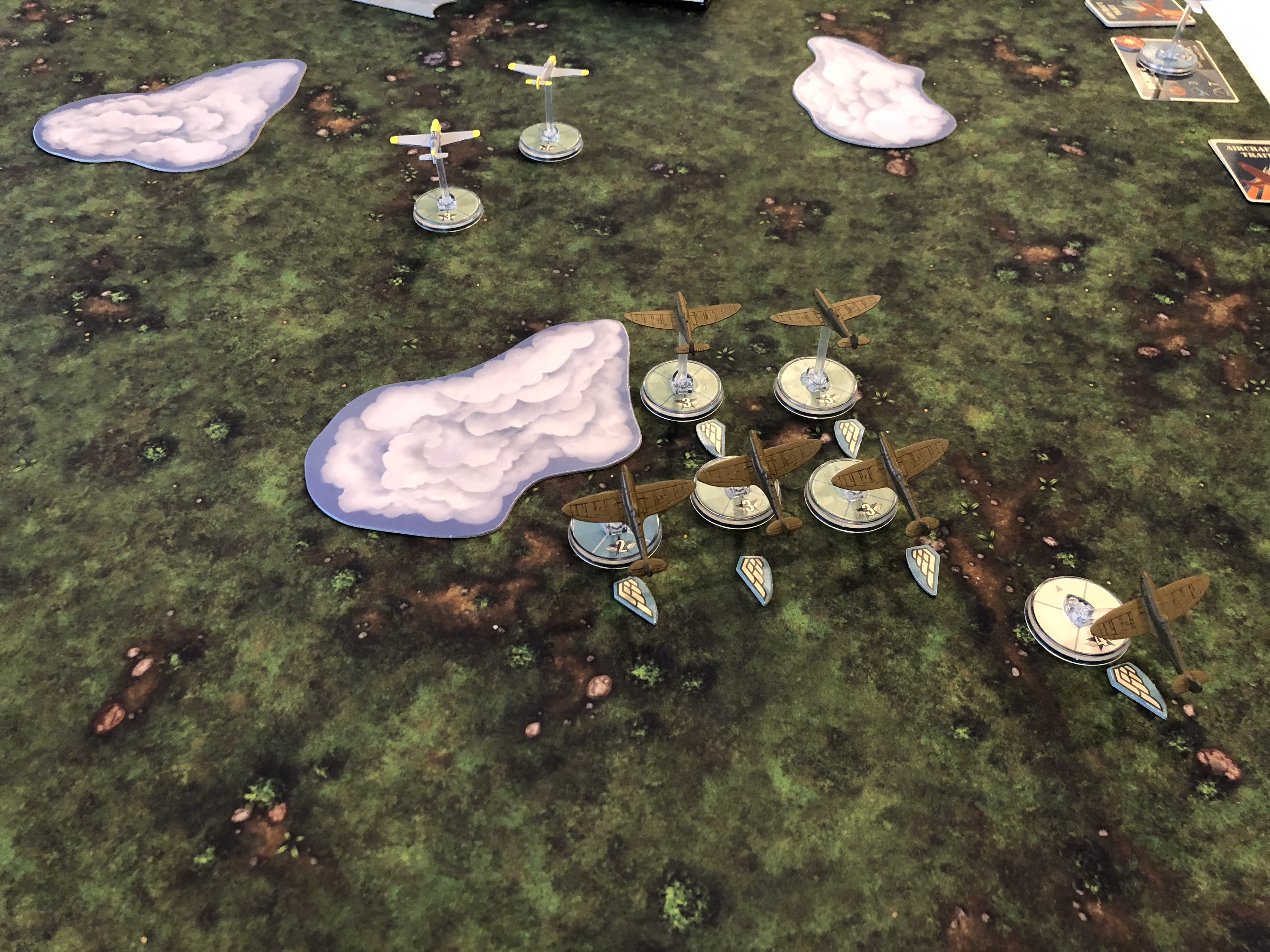
If the game we played, my whole squadron was angled in and on the attack catching some 109s off guard. There were 3, but I managed to pick on and take out a rookie very fast.
The little wing by the planes indicate a plane has gone. You’ll see the planes angled back meaning advantaged. Planes level are neutral.
Clouds completely block. No shooting. They also put you into a neutral advantage state. Running around and through clouds actually means something.
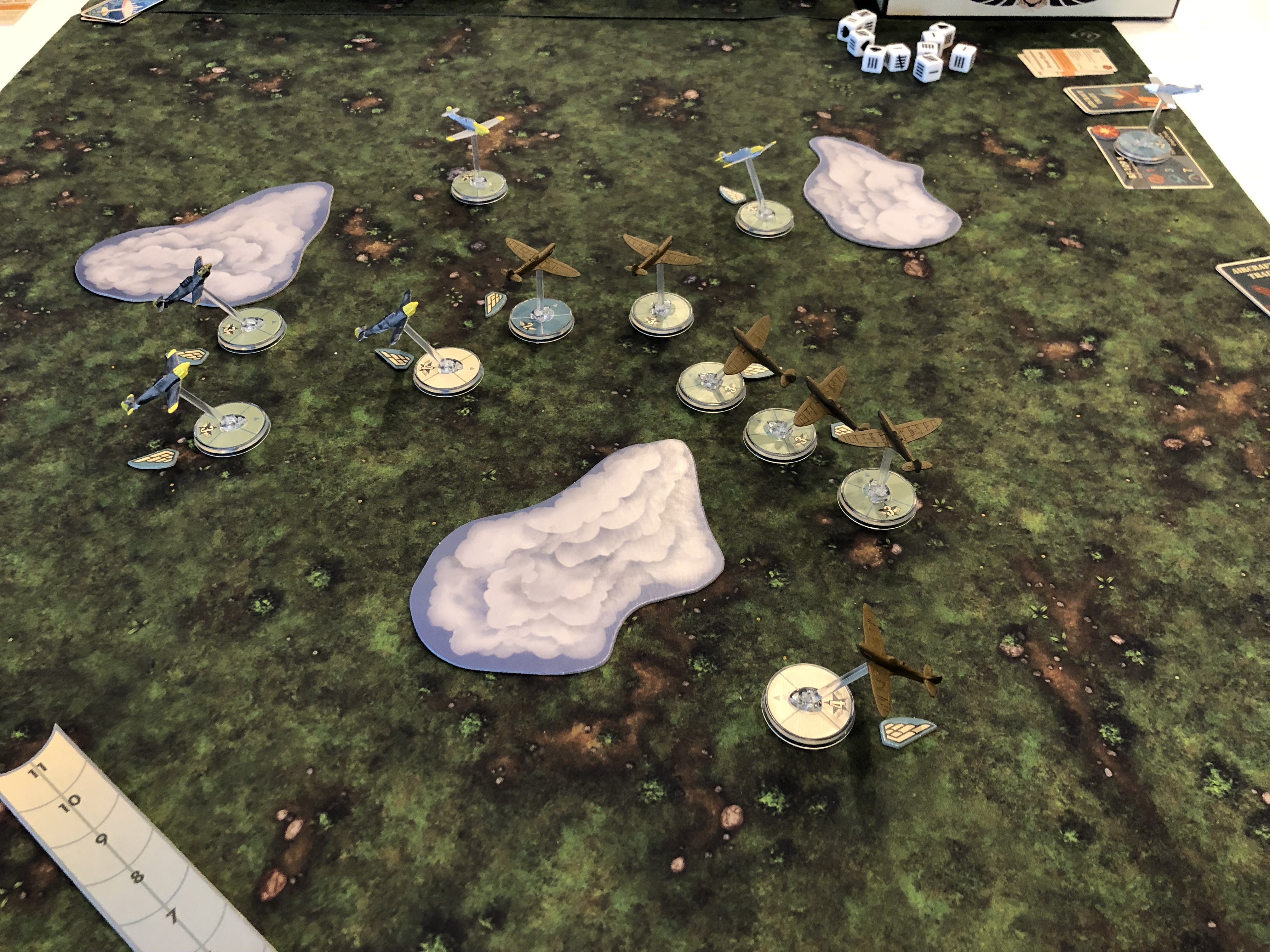
Later on in the game but my last picture. As the dog fight ensued, what I found quickly was that my planes over the course of the game where dropping from advantaged down and trying like heck to get the Germans to be into a disadvantaged state, either through out maneuvering or getting on their tail. Same for the Germans so this jockeying is a hugely critical element of the game and thus gives it a very nice flavor.
The cards I’d mentioned do add in extra situational elements, specific to the battle of Britain, mixed in with that were plane specific cards. You have 3 in your ‘hand’ so you can burn them through the course of the game, and your deck recycles so you don’t need to hold on to them as precious treasure but you don’t want to just burn them either. At one point one card definitely helped one of my guys escape from being shot down. Likewise Brooks has some situations where he caused me to pilot test and kept me from getting back into an advantaged state after I’d done some fancy flying by spending advantage.
Ad the end of the mission, I ended up having more boom tokens then planes so my squadron disengaged. Three planes all total shot down as I recall. Two spits and 1 109. A lot of my planes at the end were not in a great state when it came to advantage so the outcome seemed spot on.
All in all, on one play I’d definitely recommend the game. Planes are limited yet but they’ve more on the way. I’ve ordered the core box, so look for some games at D6 in the not too distant future.
Oh man, I’d just done some basic color blocking on the Messerschmitts, but it really pops in the photos! You can see why they’d want those hi-vis panels if they expected to have numbers.